

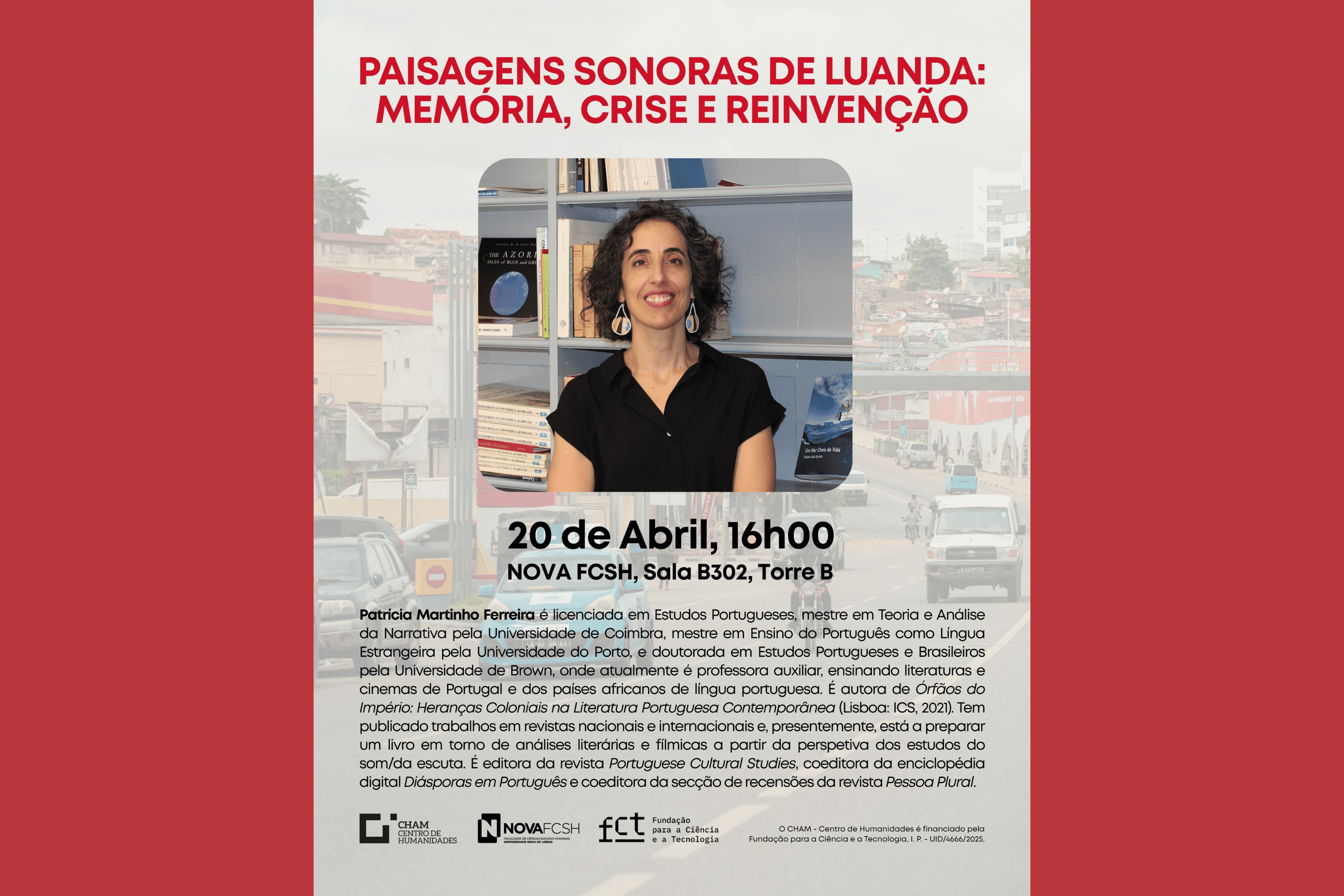
Pepetela’s novel "O Desejo de Kianda" (1995) and Fradique’s film "Ar Condicionado" (2020), both set in Luanda, offer a convergent critique of post-independence Angolan reality. Published 25 years apart by authors from different generations, these works employ the sonic dimension as a central narrative strategy, bringing to the forefront the colonial legacy, the lingering effects of the civil war, and postwar challenges related to internal migration, uncontrolled urban growth, the exploitation of natural resources, and deep-rooted socioeconomic inequalities. In this presentation, I draw upon the theoretical frameworks of sound studies and animist realism to explore the soundscape of Luanda as a microcosm of both Angolan postcolonial disillusionment and its call for change.
Patrícia Martinho Ferreira holds a bachelor’s degree in Portuguese Studies, a master’s degree in Narrative Theory and Analysis from the University of Coimbra, and a master’s degree in Teaching Portuguese as a Foreign Language from the University of Porto, and a Ph.D. in Portuguese and Brazilian Studies from Brown University, where she is currently an assistant professor, teaching literature and cinema from Portugal and Portuguese-speaking African countries. She is the author of "Orphans of the Empire: Colonial Legacies in Contemporary Portuguese Literature" (Lisbon: ICS, 2021). She has published works in national and international journals and is currently preparing a book on literary and film analyses from the perspective of sound/listening studies. She is the editor of the journal "Portuguese Cultural Studies", co-editor of the digital encyclopedia "Diásporas em Português", and co-editor of the reviews section of the journal "Pessoa Plural".
Organization
CHAM / NOVA FCSH


