

There are countless plant metaphors that populate the Western imagination, supporting a complex and nuanced thinking which reveals the way we relate to the world. The proliferation of images such as root, tree, seed, fruit, growth, branching, grafting, among others, attests to the ancient and widespread impregnation of plants in the most diverse fields of knowledge - including literature. In fact, these images have operated in the literary field as models of thought, through which heterogeneous forces and values are articulated, producing infinite forms, meanings and possibilities. In his « Prelude » to La Fraîcheur de l'herbe. Histoire d'une gamme d'émotions (Paris : Fayard, 2018), the historian Alain Corbin reminds us how, from Pliny to contemporary authors (one thinks of the ramblings of Mr Palomar, in Italo Calvino's homonymous work, who discovers in the « infinite meadow » a model of the universe that is « innumerable, unstable in its confines, opening within itself to other universes »), passing through Ronsard, Rousseau and his fascination with herborisation (Rêveries du promeneur solitaire), the Romantic poets or the precursors of modernism such as Withman (Leaves of Grass), many writers were attracted to herbaceous images, evoking the shock (material, cognitive and poetic) provoked by the mere sight of grass. Both the idyll and pastoral poetry from Antiquity or the Reverdie cultivated in the Middle Ages constitute lyrical modalisations in which the plant becomes the generative and structuring principle of specific poetic forms. In order to translate an unique way of organising narrative material, an arborescent organisation, the Middle Ages invented a new and equally revealing term, branche (« branch »), which appeared for the first time in Renart's Roman to designate one of the parts (branche IV, which tells of the misadventures of the wolf Ysengrin, trapped at the bottom of a well after falling for the fox's cunning rhetorical strategy) of a kaleidoscopic narrative par excellence.
In his essay entitled The Metamorphosis of Plants (Versuch die Metamorphose der Pflanzen zu erklären, 1790), Goethe also proposed an organic, dynamic and intuitive view of the plant world, considering that all parts of the plant derive from the successive modifications of a common archetypal form, which he called the « primordial plant » (Urpflanze). Thus, contrary to the mechanistic and classificatory scientific thinking of his time, centred on hierarchical, linear or anthropocentric structures, Goethe saw the plant as a dynamic process of continuous transformation, instigating a proliferating, open and decentralised multiplicity, thus anticipating the rhizomatic thinking of Deleuze and Guattari in Mille Plateaux (1980). In this work, the two philosophers present the concept of rhizome as a model of thought and creation that imitates plant growth, based on horizontal and multiple connections, translating into fragmented, open narratives that expand through affinity and contagion. According to this epistemological model, literature is organised by processes of germination, ramification and interdependence. The plant thus becomes the operator of an aesthetic of relationship. Authors such as Édouard Glissant reinforce this idea by defending a poetics of relationship, which adopts the rhizome as a model for a literary language that must be dynamic and incorporate the diversity and complexity of the world, valuing multiplicity and interconnection.
Thus, to think of literature from the perspective of plants and plant systems is to adopt the logic of the plant as the generative principle of literary creation itself. In this sense, the plant does not just appear, regardless of the important poetic, cultural and symbolic value it assumes in these contexts, as a simple theme or motif integrating the dynamic process of representation, but rather as a creative (imagetic and conceptual) model (generator) of new ways of thinking about the literary phenomenon and the principle of composition/organisation of the literary material itself. In fact, by evoking organic growth, multiplication, transformation or connection, plant imagery offers Western reflection a living grammar of metamorphosis and relationship, moulding the way we think, write and represent literary phenomenon.
The vegetable thus becomes a philosophy (we are thinking of the collective work Philosophie du végétal published in 2019 by Vrin), an authentic form of thought - referred to by Michael Marder as Plant-thinking (2013) - and proposes an alternative episteme to Western rationality, marked by centralities, hierarchies and binarisms, as well as an anthropomorphism (already profoundly deconstructed by Julien Offray de La Mettrie in his L'Homme-Plante published in 1748 in Potsdam) and an equally reductive universalism. This explains the growing interest of literary theory and criticism in the question of the vegetable in literature. Authors and theorists such as Michael Marder, Eduardo Kohn, Monica Gagliano, Emanuele Coccia, Rachel Bouvet, Stéphanie Posthumus, Patrícia Vieira, Jacques Tassin, among others, propose a new - or renewed - way of thinking about plants, repositioning them in contemporary thought as an active presence, ethical, ontological and epistemological subjects, producers of meaning.
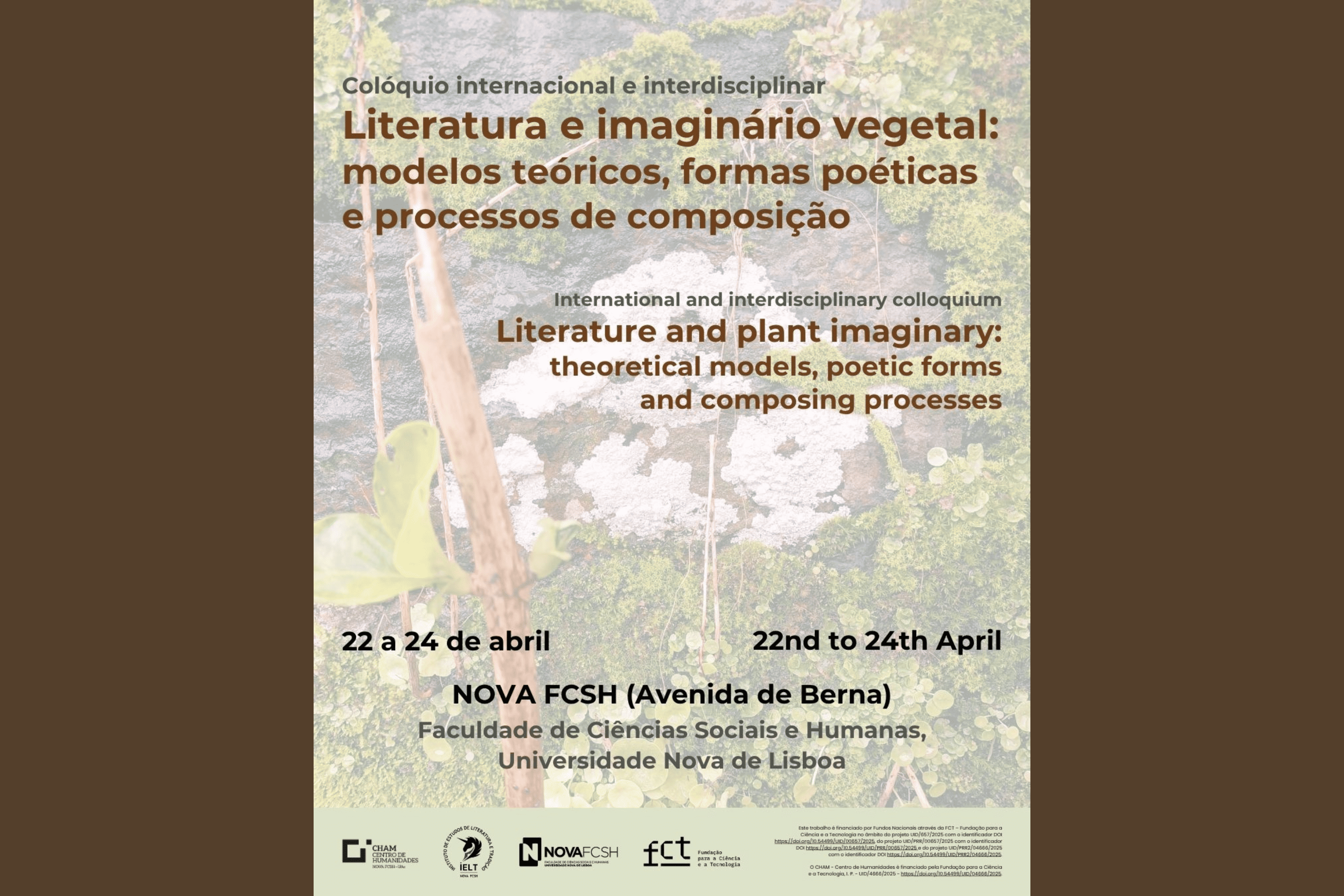
Starting from this conceptual framework, the aim of this colloquium is to reflect on the possibility of thinking about the vegetable not just as a theme or metaphor in literature, but as an epistemological and formal model that directly influences the ways of composing and imagining the literary. The aim is to promote dialogue between theoretical questions and compositional/artistic practices, based on an eminently plural and interdisciplinary approach.
Programme (.pdf)
Organization
Instituto de Estudos de Literatura e Tradição (IELT)
CHAM - NOVA FCSH


