

The “WHALE-TWIN” project, led by Cristina Brito, has won an ERC Proof of Concept (PoC) grant for 2026
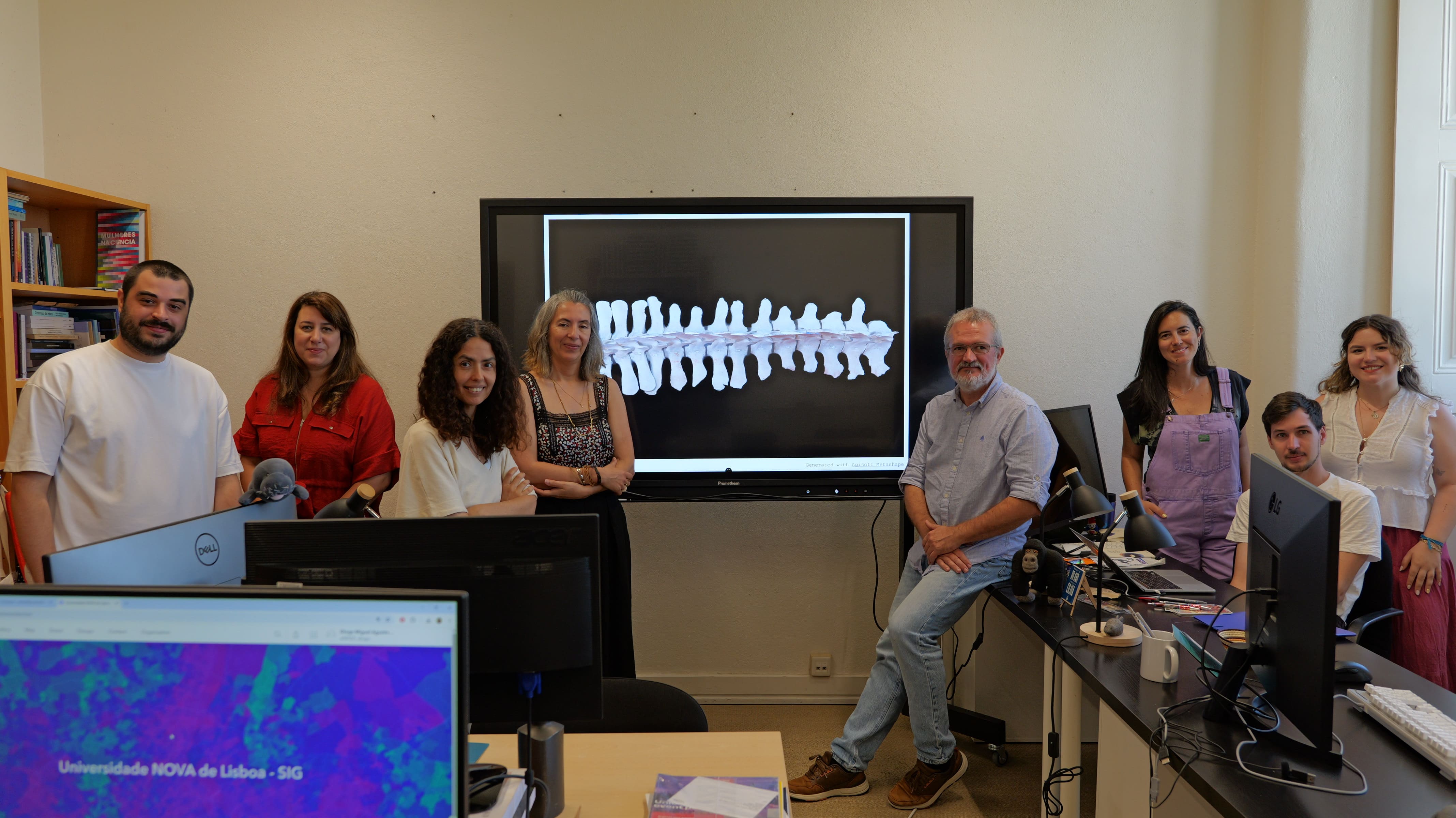
The WHALE-TWIN: Whales in the Wall: A Scalable Cultural Digital Twin Infrastructure for Europe’s Ocean Heritage project has been awarded an ERC Proof of Concept (PoC) 2026 grant worth 150,000 euros, with an expected duration of 18 months (2027–2028). Led by Cristina Brito, a researcher at CHAM and head of the 4-Oceans project, WHALE-TWIN aims to demonstrate how digital technologies can contribute to the preservation and promotion of oceanic and cultural heritage.
The research takes as its starting point a seemingly simple object – a whale bone – in order to answer a broader question: how can we recover and make accessible the knowledge hidden within the remains of the past? WHALE-TWIN will create a digital twin of a whale bone – a virtual representation of the physical object that integrates different layers of information, such as historical, archaeological, environmental and cultural data.
WHALE-TWIN stems from the 4-Oceans project (2021–2027), the winner of an ERC Synergy Grant, which is dedicated to studying the importance of marine life to human societies between 100 BC and 1860 AD. This proof-of-concept project benefits from the vital partnership of Peniche Municipal Council, which holds the bone collections that form the basis of the project, as well as collaboration from the University of Minho, CNANS – the National Centre for Nautical and Underwater Archaeology, the company Iconictheory and the Bergen University Museum.
This is the first ERC Proof of Concept from the Faculty of Social and Human Sciences – NOVA FCSH and the first from NOVA University Lisbon outside the fields of Chemistry, Life Sciences and Physics/Engineering, reinforcing the role of the Humanities in innovation and in creating new ways of understanding and protecting our ocean heritage.
The WHALE-TWIN team also includes researchers from CHAM – NOVA FCSH: Nina Vieira, Carla Vieira, Catarina Garcia and Mafalda Pacheco, as well as Daniel Alves, a researcher at IHC – NOVA FCSH, and Rui Venâncio, a PhD student at IEM – NOVA FCSH.


