

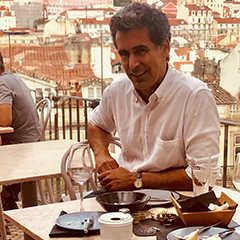
Senior Researcher . Associate Professor (with Habilitation) at NOVA FCSH
Research Group
Social, Economic, and Political Dynamics
ORCID
Ciência ID
NOVA RESEARCH PORTAL
My research centers on the history of early modern Iberian polities and their imperial governance across the Atlantic, with a particular focus on the Iberian Union (1580–1640) as well as the political and administrative culture of the late seventeenth and eighteenth centuries. I served as the King Juan Carlos I of Spain Chair in Spanish Culture and Civilization at New York University, and have held visiting professorships at the École des Hautes Études en Sciences Sociales, the Université de Toulouse Jean Jaurès, the Universidad Pablo de Olavide, and Yale University. In 2026, I was a Member of the School of Historical Studies at the Institute for Advanced Study in Princeton.
An outcome of my research is the volume I co-edited with Nuno Gonçalo Monteiro, Political Thought in Portugal and its Empire (1500–1800) (Cambridge University Press, 2021). My work also addresses representative assemblies and political participation, as explored in “Representative Institutions and Parliamentary Culture in the Portuguese and Spanish Empires (c. 1500–c. 1700)” (Transactions of the Royal Historical Society, 2025).
Additionally, I examine Colonial Brazil, focusing on the legal and moral categories imposed on Indigenous populations alongside their forms of resistance, a topic I analyzed in “Debating the Enslavement of Black Africans and of Indigenous Americans (15th–17th centuries): Contrasts, Connections, and Entanglements” (Global Intellectual History, 2026). Finally, I delve into the memory and historiography of the Portuguese empire, reflected in "Reassessing the Portuguese Imperial Past: Scholarly Perspectives and Civic Engagement" (Journal of Lusophone Studies, 2023) and in the volume I co-edited with Manuel Herrero Sánchez and Jonatán Orozco, The Asiento System and the Transatlantic Trade in Enslaved Africans (circa 1580–1750) (Brill, 2025).
The contents of this page are the responsibility of the researcher.


