

Start . 2024
Duration . 24 months
Principal Investigator . Edite Alberto (CHAM)
Co-Principal Investigator . João de Figueirôa-Rêgo (CHAM)
Website: https://sites.google.com/view/
INSTITUTIONS
Main Institution
CHAM — Centro de Humanidades
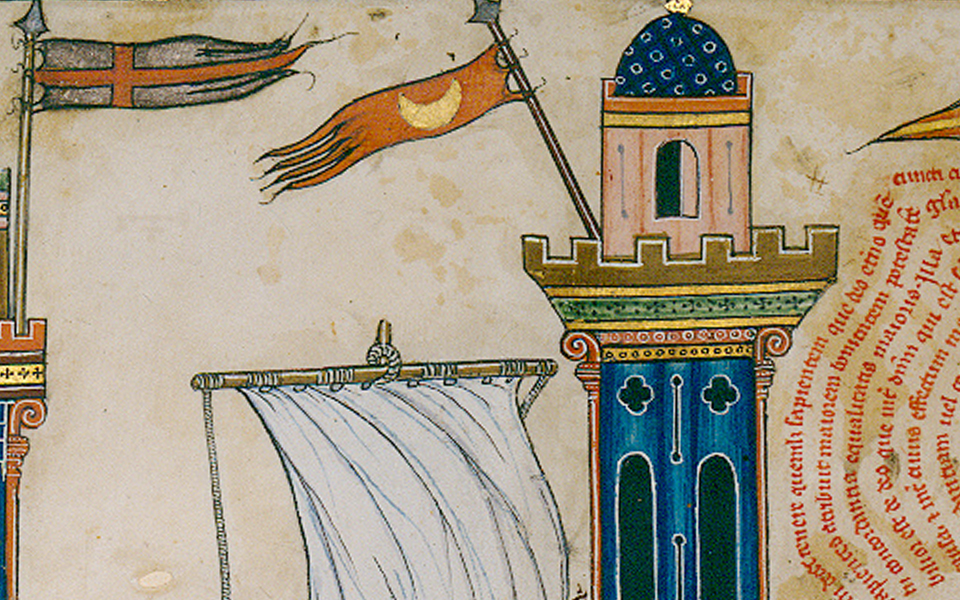
The long history of the relations between the Iberian Peninsula, North Africa and the Levant is not without contradictions: a unique history, made up of conflicts, but also common interests and strongly interconnected social and economic dynamics. A history built upon contact with the Other (seen as "different") and the consequent practice of alterity or otherness. A negative and positive alterity, which, in the latter case, often led to fruitful cultural exchanges resulting in profound experiences of interculturality.
Europe is increasingly heterogeneous ethnically, with constant migratory flows and problems of integration of migrants. Therefore, based on knowledge of the deep roots of this coexistence, we intend to understand and outline actions that can contribute to the understanding and implementation of the European Commission's integration policies.
KEYWORDS: Western Mediterranean; Migrations; Identity formation; Alterity; Interculturality.
Goals
Based on the theoretical framework at the level of institutions and the daily life and local societies of both Christian captives in Islamic lands and Muslim captives in Christian territories, we intend to develop the theme of more or less effective integration and coexistence of individuals of different origins. In a second line of analysis, arising from the development of the previous problem, we aim to analyse how religious, political and judicial institutions adapted to this reality and how society integrated (or not) captives into daily life. In this regard, it will be interesting to study how this connection between peoples affected identity, cosmopolitanism, places of socialization, or even local languages and the lingua franca used to communicate; or, on the other hand, study the archival practices of the territories of “arrival”, for material culture constitutes a decisive element in the establishment of identity constructions and subsequent exercises of alterity.
We plan to develop four complementary areas of work that will be the basis for the groups proposed in the application for a COST action:
. COEXIST INSTITUTIONS – Relations between the European and North African sovereigns and how these shaped a set of common diplomatic practices and norms: passports and safe-conducts; peace and trade treaties; shared economic exchanges; and commercial, political, and military negotiations between the two sea coasts;
. COEXIST FRONTIERS – the coexistence of members of different religious confessions and nationalities called into question the legal models, cultural and social standards of each group, which were forced to share the same urban space and had to, whether they wanted to or not, reach agreements to ensure coexistence;
. COEXIST SOCIETY – integration and inclusion of migrants in the social and productive fabric and the adopted policies; exchanges that, gradually, wove a network of contacts, mediators and references for credits, exchanges and circulation of goods;
. COEXIST WITH SUCCESS – positive integration practices and their influence on the host societies; multiculturalism and cultural and social development.
Edite Alberto . Coordenadora
João de Figueirôa-Rêgo . Co-coordenador
Diogo Reis Pereira (CHAM)
Paulo Catarino Lopes (IEM, NOVA FCSH)
Maria Augusta Lima Cruz (CHAM)
Rui Manuel Loureiro (CHAM)
Ricardo Sá Torres (Universidade do Minho)
Collaborating researchers / consultants
Aurélio Vargas Díaz-Toledo, Univ. Complutense Madrid, Spain
Beya Abidi-Belhadj, Université de la Manouba, Tunisia
Fátima Silva, Lab2PT/IN2PAST; Casa de Sarmento, Universidade do Minho, Portugal
Giulia Danieli, CEI, ISCTE, Portugal
Joseph Jackson-Eade, Università di Bologna, Italy
Luís Costa e Sousa, CHAM, NOVA FCSH e UAc, Portugal
Michel Bosco, Universidad de Valencia, Spain
Miguel Soto Garrido, CSIC, Spain
Mimoun Aziza, Universite Moulay Ismail de Meknes, Morocco
Nicola Melis, Università degli Studi di Cagliari, Italy
Ruben Gonzalez Cuerva, CSIC, Spain


